Musicians
- Adrian Crookston; accordion
- Brayden Schultz; blocks, triangle, congas
- César Haas; guitar, cavaquinho
- Dave Bjur; upright bass
- Evan Mulroy; electric bass
- Greg Yasinitsky; tenor saxophone
- Jake Svendsen; piano
- Kate Skinner; piano
- Tim Zilar; toms; bongos
Production Staff
- Production/ Stage Manager – Shaun Sorenson
- Production Crew – Ailee Chávez, Nicole Ehr, Tristan Donaldson, Zachariah Mayberry
- Audio Recording – Jon Melcher
- Wardrobe Design – Ginger Sorenson
And special thanks to Michelle White and Blaine Ross
PROGRAM
Titles are links to video of performance
I.
Donna Lee – Miles Davis* (1926-1991)
Variations on a Ghanaian Theme – Daniel Levitan (b. 1953)
Um Tom para Jobim – Sivuca (1930-2006)
II
The Doctor – Greg Yasinitsky (1953)
Freedom Jazz Dance – Eddie Harris (1934-1996)
“III“
Brasileirinho – Waldir Azevedo (1923-1980)
Dolphin Dance – Herbie Hancock (b. 1940)
¡Dale! – Doc D (b. 1963)
NOTES
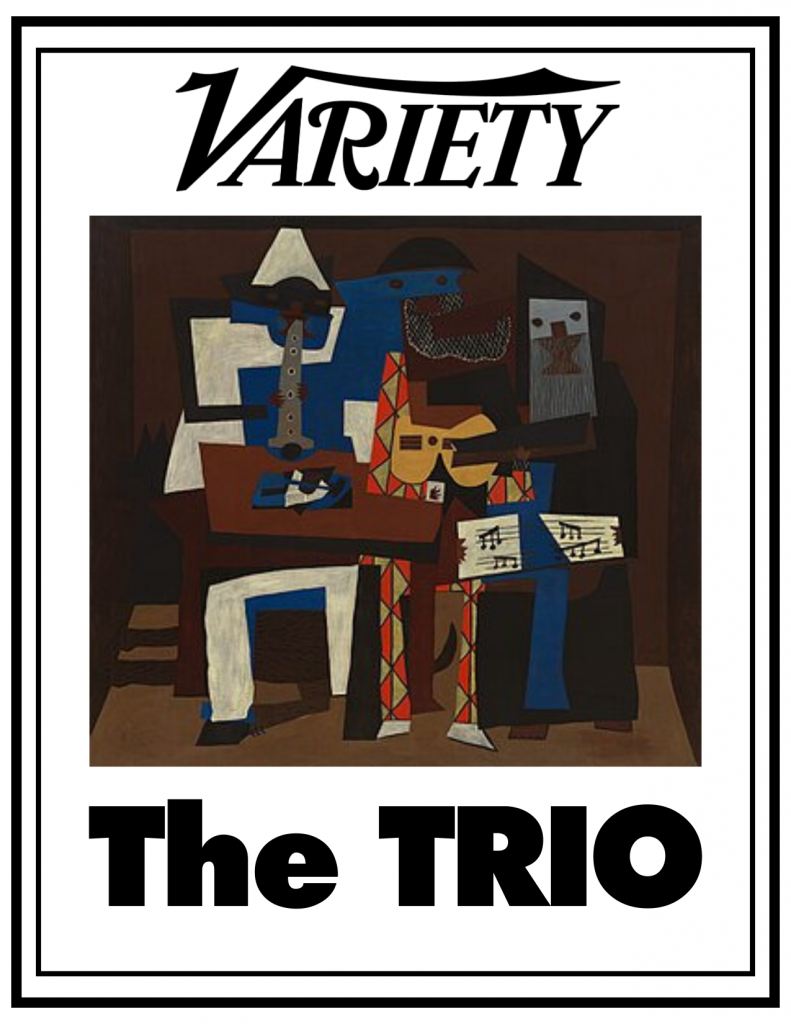
Perhaps the lowest common denominator of music “ensembles,” the trio puts front and center a distilled presentation of what is arguably the most elemental trio of musical elements – melody, harmony, and rhythm. At the same time, it affords all players space for creative expression without infringing upon each other. In the two-dimensional world a triangle is the most basic polygon and considered the most stable of visual forms. In the three-dimensional world (that “three” gets you height, width, and depth) a tripod is the fewest number of legs that can stand on their own. And while a physical pyramid has four sides, only three are visible and all four sides are…triangles.
This concert is a celebration of three. Though not the lowest prime number (2 holds that distinction), it is arguably the most fundamental to much of human endeavor and thought.
Donna Lee
Donna Lee is one of those tunes in the canon of jazz standards that separates the men from the boys, the women from the girls, the “cans” from the “cannots” (or can’t yet), or whatever I’m-closer-to-‘there’-than-the-average-bear comparison you want to use. It is a contrafact, that is, a newly composed melody that aligns with a preexisting harmonic progression. This particular standard was composed on the progression to “Back Home Again in Indiana,” itself becoming a jazz standard after being recorded by the Original Dixieland Jazz Band (ODJB). That was after it was originally composed as a Tin Pan Alley pop song. I should note that the ODJB (or their producers) called themselves the “creators of jazz” which was just one example of what has been a long tradition of those in a position of privelege receiving the benefits of others’ creativity.
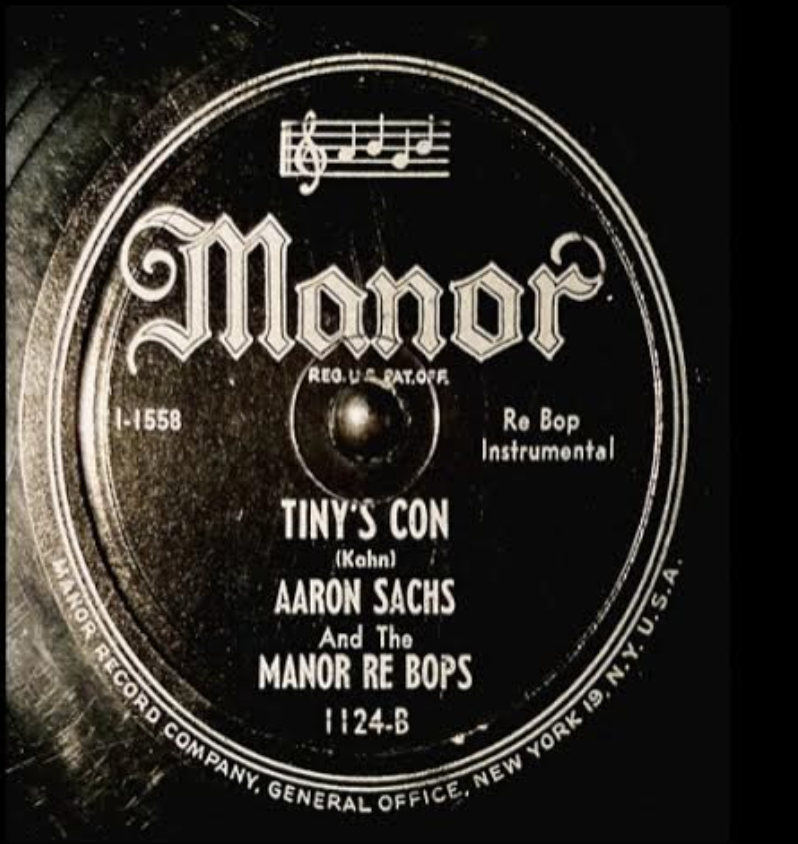
Donna Lee’s melody was long attributed to Charlie Parker, then claimed by Miles Davis, only to be pronounced by Gil Evans as the work of drummer Tiny Kahn, who taught it to Davis, who taught it to Parker. Kahn did record the tune “Tiny’s Con” (see what he did there? – think of “Con” as possibly short for “contrafact”). That was in 1946, the year before Parker’s recording of Donna Lee (with Miles Davis😏). Though the bop style applied to the song’s harmonic progression are likely to independently lead “contrafactors” down simliar paths, there are sufficient elements from the former present in the latter to fuel spirited discussion as to provenance.

Writing for Jazz Times, Mac Randall observed that the jazz piano trio comprising “piano, bass, and drums make up a basic unit, an essential building block of jazz. In this classic three-piece format, there’s both no place to hide and no limit on the imagination.” This trio features Jake Svendsen on piano, a reflective player whose angular and sometimes unpredictable playing inspires lively musical dialog. It is Svendsen’s new melodic material, composed for this concert, is heard during the head (the pre-composed melody heard in most jazz tunes prior to improvisation) and at the end of the tune. Thus, much like a city that has been built over several prior iterations, there is new material by Jake added to a tune that was adapted by Bird from a melody taught to him by Miles, arguably from a contrafact by Tiny based on a jazz standard recorded by the ODJB that was originally a pop song (for its day) by James Hanley…which was inspired by a previous hit “On the Banks of the Wabash, Far Away.” You’ll be quizzed on this later!
You can find information about bassist Dave Bjur in the notes for “Dolphin Dance”
Variations on a Ghanaian Theme
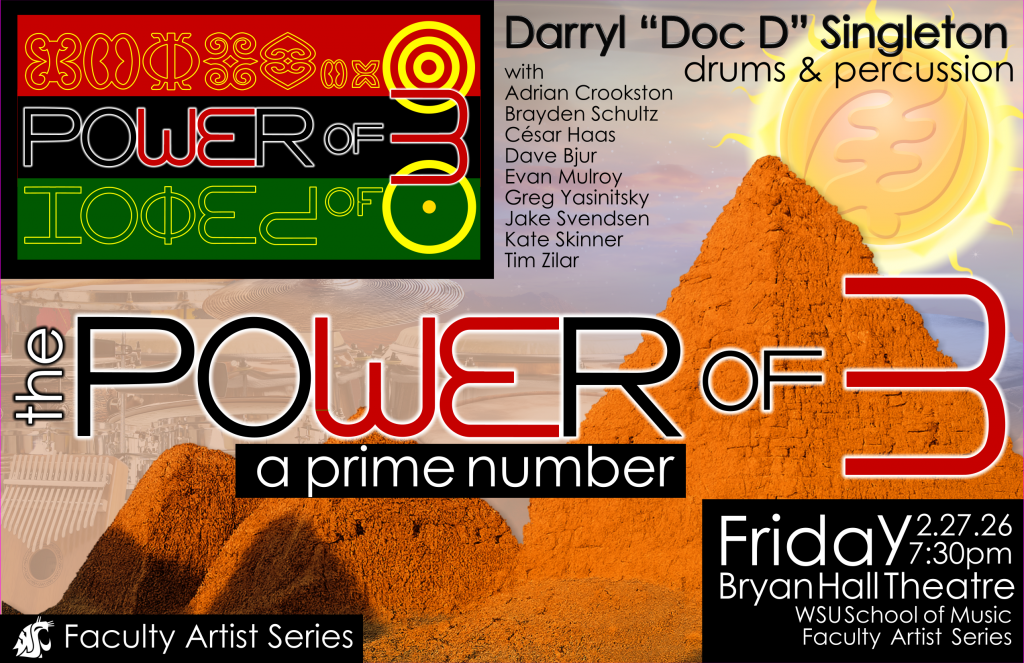
As I often discuss in my lecture classes (Black American Music and Music and Social Justice) one aspect of being a Black American is that most of us do not have any specific sense of our African heritage. That is, beyond the generalities afforded me by DNA testing, I don’t know the village, town, or region my “great greats” hail from. That also means no knowledge of any specific cultural markers, products, or traditions. So, I latch on to what I can. One such cultural construct is the symbological system called Adinkra, associated with the Akan people of current-day Ghana. Gye Nyame, the most often seen symbol, holds special significance to me as a Christian. It represents the omnipotence, omniscience, and immortality of God. The symbols on the poster I designed for this concert are all from the Adinkra system and the corresponding alphabet created by Charles M. Korankye, M.D.; they spell out “Power of 3.”
As I often discuss in my lecture classes (Black American Music and Music and Social Justice) one aspect of being a Black American is that most of us do not have any specific sense of our African heritage. That is, beyond the generalities afforded me by DNA testing, I don’t know the village, town, or region my “great greats” hail from. That also means no knowledge of any specific cultural markers, products, or traditions. So, I latch on to what I can. One such cultural construct is the symbological system called Adinkra, associated with the Akan people of current-day Ghana. Gye Nyame, the most often seen symbol, holds special significance to me as a Christian. It represents the omnipotence, omniscience, and immortality of God. The symbols on the poster I designed for this concert are all from the Adinkra system and the corresponding alphabet created by Charles M. Korankye, M.D.; they spell out “Power of 3.”

Daniel Levitan, in researching (or perhaps just searching) sources for compositions, came across a recording of traditional Ghanaian drumming. He heard the master drummer play the pattern that would become the principal motif for this work. He recounted to me that he had a keen interest at the time in rhythm as an organizing element for composing and ran that rhythmic cell and its derivatives through a series of developmental techniques that have been with us since the time of J.S. Bach and before. He also employed tihai, a cadence from Indian classical music that involves repetition of a phrase three times, with specific gaps in between, in such a way that the phrase ends on “one.” There are also specific instructions for the performers towards exploiting (in a good way!) each instrument for nuance of expression. And, he purposed to write in such a way that the music would sound as if it were being created in the moment, rather than being read off of a page.

Levitan chose the instrumentation from a desire to use items likely present in the average 1970’s high school band room that could also evoke the feeling of African folk drumming. The two cowbells are an adaptation of the gankogui bell. The blocks are akin to many traditional wood-based sounds and the toms stand in for hand-played membranophones. Info on the players can be seen below in ¡Dale!
Um Tom para Jobim
Antônio Carlos Brasileiro de Almeida Jobim, known much more accessibly as Tom Jobim, is almost inarguably the most famous and iconic Brazilian composer in the jazz world. “Garota de Ipanema” (The Girl from Ipanema) is one of the most recorded songs of all time and is the bossa nova that many use (hum, sing, etc.!) to describe or define the style. Savuca, the professional name of Severino Dias de Oliveira recorded Um Tom para Jobim (A Tone [sound] for Jobim) in 1992 on the album Pau Doido (We’ll just go with “Crazy Guy” as a translation…).
Sivuca, an accordionist, guitarist, composer, and singer made his radio debut at the age of 15. Later moving to New York, he worked with the likes of Miriam Makeba, Harry Belafonte, and Toots Thielman, among others. Having composed songs that have become standards in their own right such as “João e Maria” and “Feira de Mangaio,” “Um Tom para Jobim” amounts to a legend saluting an icon. Sivuca’s music spanned many genres, including jazz, and he often integrated the styles of his home in northeastern Brazil, having done much to popularize forro rhythms, the basis of the arrangement heard in this performance.
Moscow native Adrian Crookston has studied and performs in various genres that feature the accordion (polka, forro, zydeco, cumbia, etc.). A multi-linguist as well as multi-instrumentalist, he has founded or co-founded various projects and has performed on 4 continents.
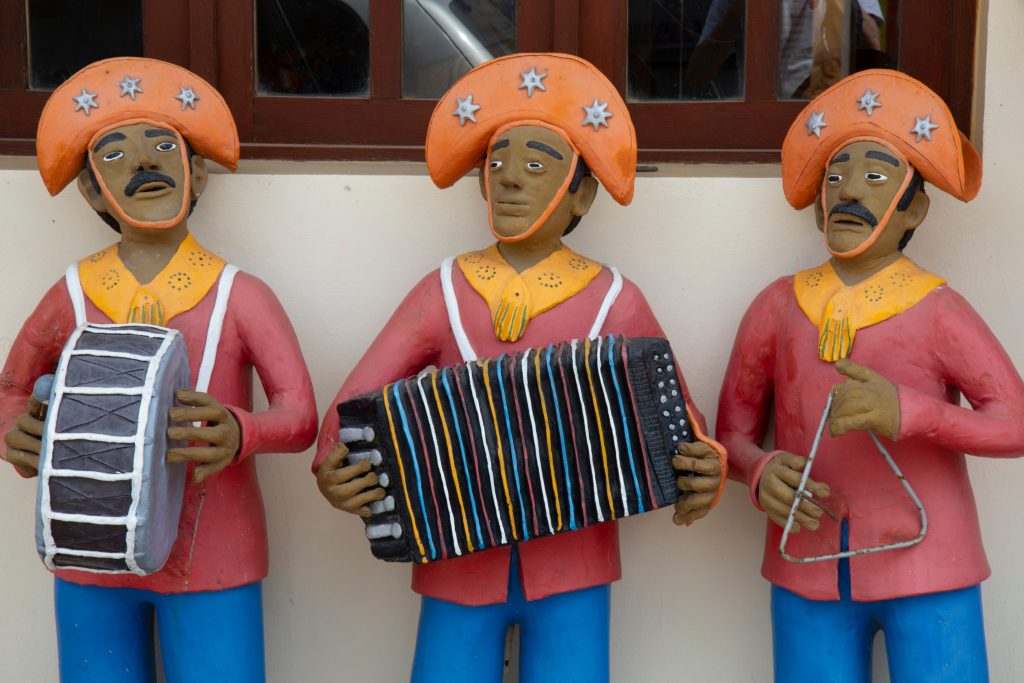
Accordion, zabumba, and triangle are an iconic ensemble for forro. Odds are that as you are reading this, Brazilians in a bar, restaurant, party, or street corner are dancing to music produced by this same combination of instruments, and perhaps to this same tune!
The Doctor
“The Doctor” is a new composition, dedicated to master percussionist Darryl “Doc D,” Singleton, written especially to be premiered at Doc D’s WSU Faculty Artist Series Concert, The Power of 3. “The Doctor” is medium-tempo, shuffle-blues scored for jazz trio: drums, bass (the wonderful Dave Bjur) and saxophone, and is inspired by the jazz trios recorded by saxophonists Sonny Rollins, Joe Henderson and so many others. “The Doctor” starts with some trading between saxophone and drums, followed by a blues melody with bebop harmonies and a flexible, open solo section.
-Greg Yasinitsky, 2026
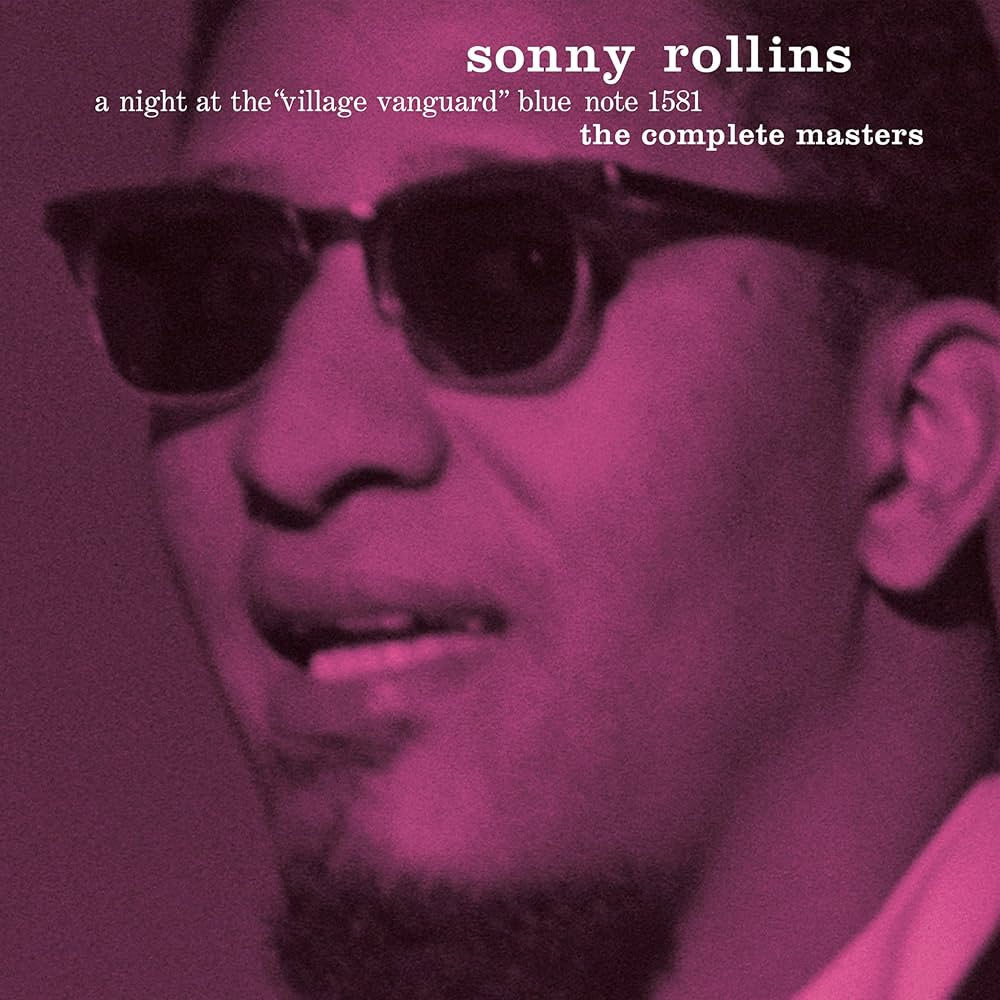
As mentioned by the composer above, Joe Henderson and Sonny Rollins are two tenor sax giants who recorded sans piano with bass and drums, albeit possibly for different reasons. Rollins stated, “I was kind of disappointed with piano accompaniment… They got in the way. …I ended up getting bugged at all piano players. And got this idea that I didn’t need piano. I feel it’s worked out much more successfully…” A more common sentiment for playing jazz without a chording instrument was expressed by writer Peter Watrous – “…groups that perform pianoless often become more flexible; they open up. Without the pianist dictating the background, improvisers can look into the back alleyways of a tune without fear of playing clashing notes.” Evidence points to Henderson’s sentiments as paralleling that latter school of thought.
Greg Yasinitsky is a WSU Regents Professor Emeritus, is in the Washington Music Educators Association Hall of Fame, composer or arranger of over 200 jazz band charts that have been performed in over 40 countries (including commissions for David Sanborn, Clark Terry, Dave Liebman and the USAF “Airmen of Note”), and an aggressively swingin’ tenor player.
Freedom Jazz Dance
Music Radar writer, adjunct professor at several universities, and music blogger Ethan Hein wrote of the piece “Freedom Jazz Dance” and its composer Eddie Harris – “As befits an eccentric yet popular song, Eddie Harris was an eccentric yet popular guy.” He also called Freedom Jazz Dance “arguably the weirdest jazz standard…in the core repertoire.” Harris had an eclectic career that included a stint in the 7th Army Band alongside Cedar Walton, Don Ellis, Leo Wright, and Don Menza. He also experimented with inventing, creating and performing on the reed trumpet, saxobone, and guitorgan. Each of those combined elements, usually mouthpieces and bodies, of the instruments “portmanteau’d” into their names. His debut album featured his jazzed take on the theme to the 1960 film “Exodus.” That reimagining was the first jazz single to be certified gold. And, he performed and/or contributed much of the music for the hit, The Bill Cosby Show (the one that aired 1969-71).
Recordings of “Freedom Jazz Dance” have been described by different writers as proto-funk, post-bop, hard bop, funky, and soul-jazz. Beyond Harris’ original, and Miles Davis’ more famous effort that was recorded a year later and popularized the tune, a diverse cadre of artists including icon Woody Herman, Joey Alexander (feat. Chris Potter), The U.S. Army Blues recorded the tune. Samples of Davis’ recording appear on tracks by Ed OG and the Bulldogs, Fu-Schnikens, and The Pharcyde.
“Freedom Jazz Dance” has an angular melody over a Bb “home note” with no composed evolving harmonic progression. Those elements combine to allow freedom (it’s literally in the name!) in the expression of the written melody as well as the style and complexity of arrangement, as can be heard in the various recordings. The arrangement heard in this concert was created as a collaborative effort for this occasion.
I should also note that “Freedom Jazz Dance” was the inspiration for the melody of my own composition “Afratin,” a student favorite over the years. Eddie Harris made a statement 5 years before his death that particularly resonates for me-
“I’m a serious musician, and I don’t shuck and jive when I pick up m y horn, but I don’t like taking myself too seriously either On stage, i t would be boring i f all I was play complex pieces for hours and hours. I like to play music that is entertaining, that tries to find new directions, and makes people open their eyes and look up.”
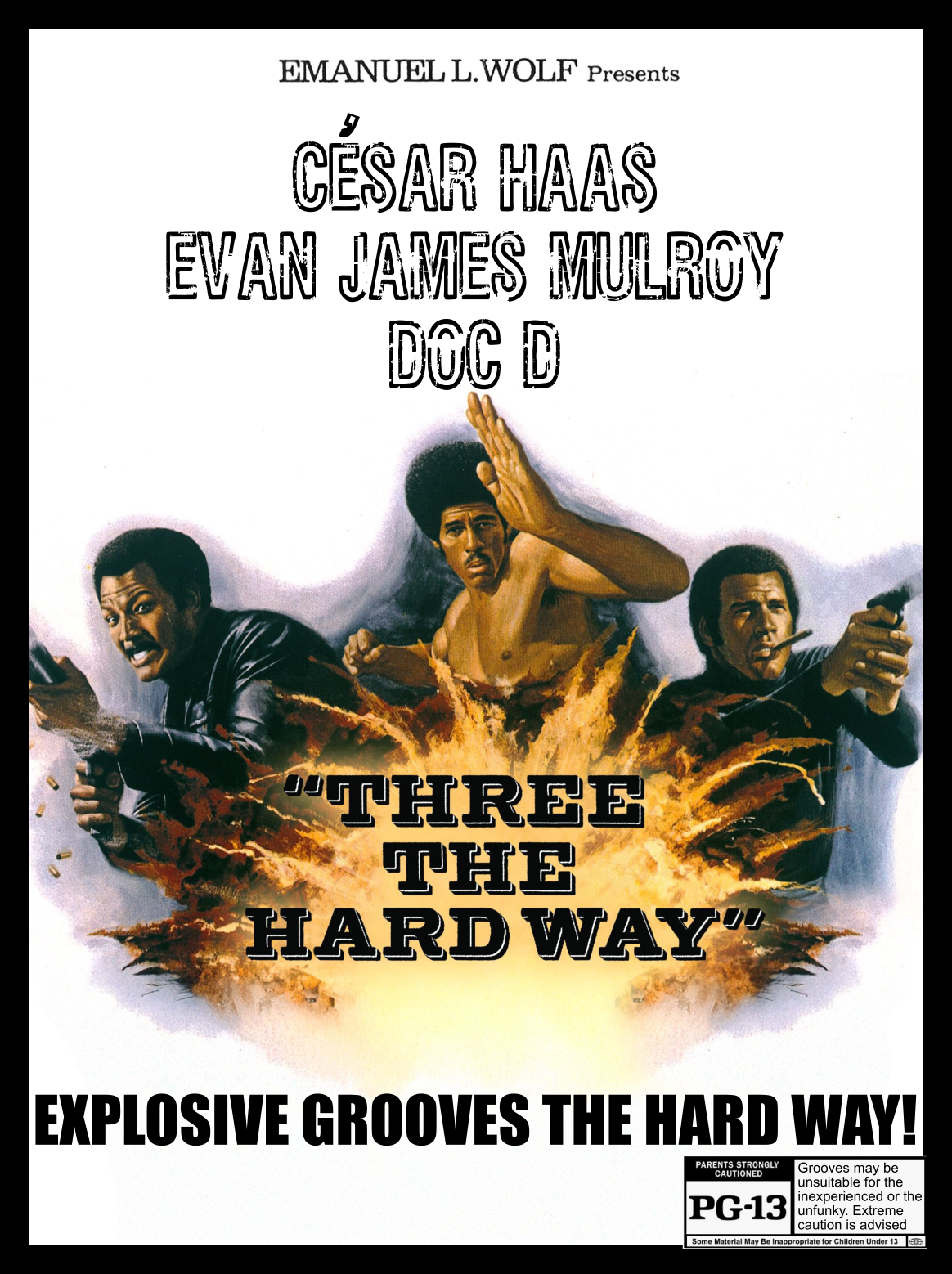
Rock “power trios” and jazz guitar trios are both prevalent staples of their respective genres. It is no surprise that the same would be true of fusion, with Pat Metheny and John Scofield being only two notable examples.
César Haas is WSU’s professor of guitar and hails from Porto Alegre in southern coastal Brazil. His group Tres Mâis has featured in concerts on two continents with world renown artists such as Nelson Faria, Bobby Militello (Dave Brubeck), and Rafael Barata (Eliane Elias). Evan Mulroy is an electric bass specialist hailing from Boise, Idaho.
Brasileirinho
“Brasileirinho” (Little Brazilian) was composed by Waldir Azevedo, cavaquinho “shreddist,” in 1947 and released on record two years later. It became one of the most important choro compositions of all time and is closely associated with the generally happy, upbeat genre. The 2005 documentary Brasileirinho, named after the song, presents choro as the first “genuinely Brazilian urban music, predating samba and bossa nova.“ At some point “Brasileirinho” was voted by the Brazilian edition of Rolling Stone as the 53rd greatest Brazilian song of all time.
Choro is traditionally an instrumental genre, however Ruy Pereira da Costa composed lyrics for Brasileirinho sometime after its original 1949 release. They are a celebration of choro music and a (possibly not so?) tongue-in-cheek warning about what can happen when a brasileiro (Brazilian!) hears (or plays?) the music. We’ll see what happens this time as the soloist for the selection is none other than César Haas…Brazilian👀
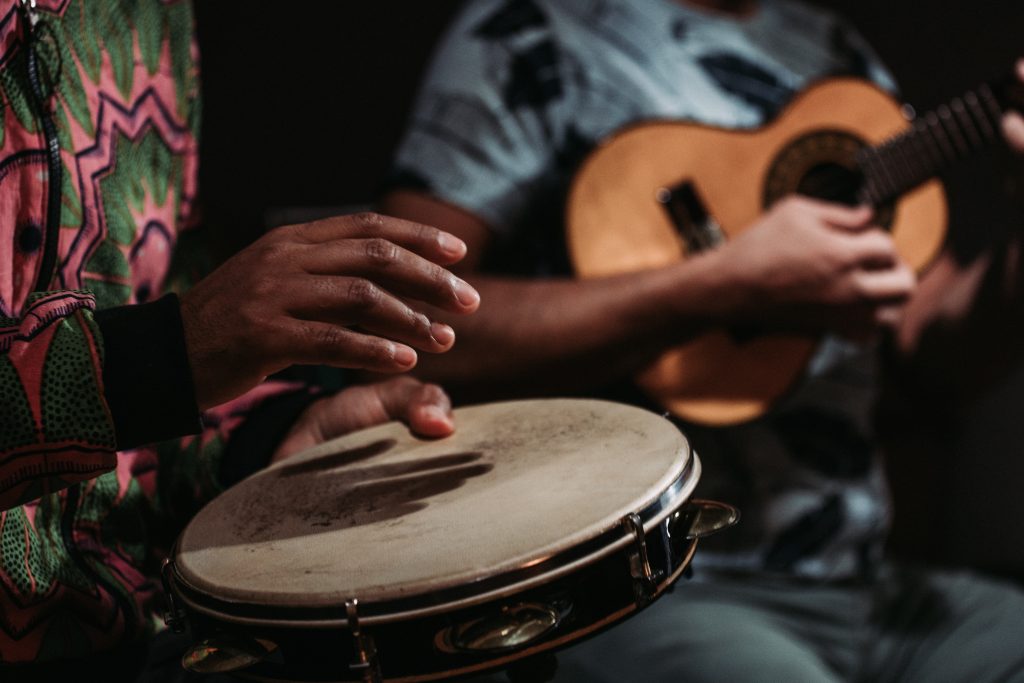
Accordion, cavaquinho, and percussion are all instruments integral to Brazilian music, though perhaps not traditionally in the particular combination assembled for this concert. I start this piece playing the pandeiro, the Brazilian species of the genus that also spawned the European/American tambourine, the ancient Hebrew tof, and the Middle Eastern riq.
Dolphin Dance
When I hear people ask musicians, “Who’s your favorite X;” they are as likely as not to get a
definitive answer. After years of fielding the “favorite” question (or perhaps I should say
“least favorite question”!) I have come conceptualize “favorite” as “if I could have only
one.” So, despite not appearing on my “favorite” album (Freddy Hubbard’s Straight Life), my
favorite (I’ll stop using written quotes but please continue imagining conversational air
quotes every time I say “favorite”) musician would be Miles Davis. Why? Because if I only
listened to Miles Davis, I’d be cyclically listening to most of any other favorites I might
mention whether referring to drummers, or other instrumental musicians, which brings me to Herbie Hancock, pianist and composer. Hancock formed a group of recent Davis Quintet alums, added Freddie
Hubbard (small world for my favorites!) and recorded the concept album, Maiden Voyage,
upon which the Hancock composition “Dolphin Dance” was the last track (also a favorite).
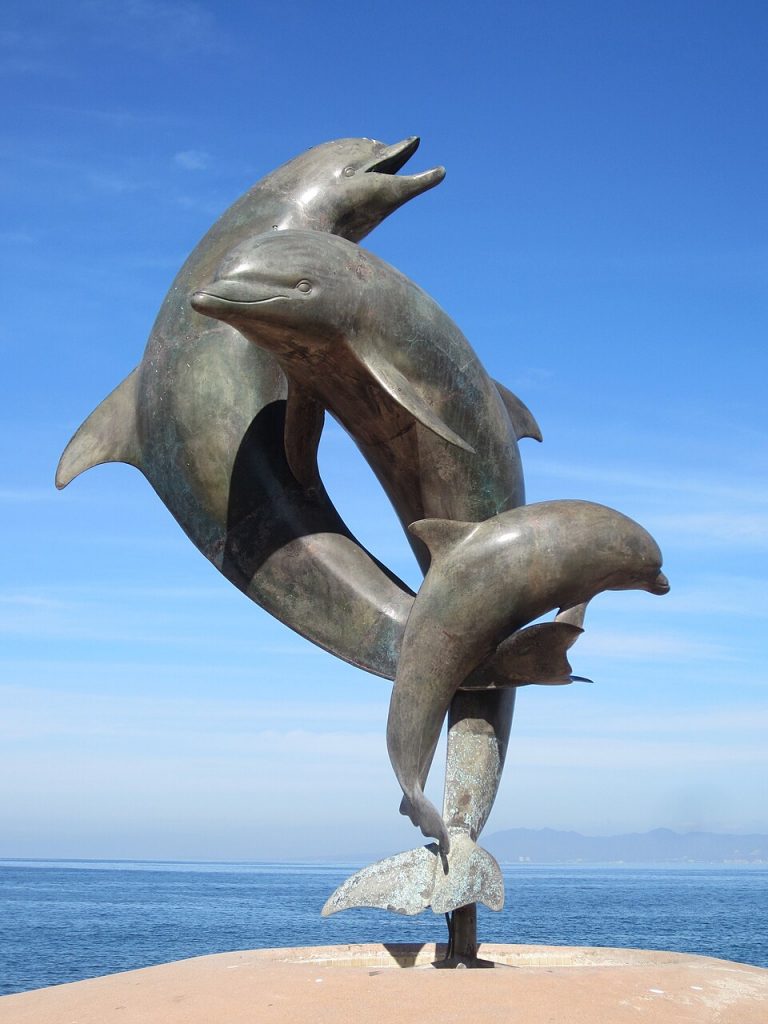
“Dolphin Dance” combines functional harmony with modal concepts. Modal jazz is characterized by this – rather than being centered on a “home note” or key with more traditional chords (for whatever “traditional chords” is worth in jazz), it is based on modes. “Dolphin Dance” is beautiful. It is gently complex, and it evokes ethereal and ephemeral images of dolphins dancing.
Pianist, Composer, Vocalist, and professor Kate Skinner has won a Downbeat award for Outstanding Vocal Performance and a Jazz Education Network award for composition. She is at home across several genres from neo soul to celtic. As a jazzist, she is intimately intuitive with a unique sense of groove.
Dave Bjur traces his own heritage as a bassist through John Clayton, his private teacher and mentor, to the icon Ray Brown, who was to John Clayton as Clayton was, in turn, to Bjur. Dave must have learned his lessons well as he was in time selected to fill bass chair in the elite Clayton-Hamilton Jazz Orchestra (yes, that same Clayton who was his mentor). Oh, and there was also that tour with the Glen Miller Orchestra. Additionally, Dave Bjur is an accomplished audio engineer (with international credits!) who managed the WSU recording studio (now “4th Floor Studios”) for over a decade.
¡Dále!
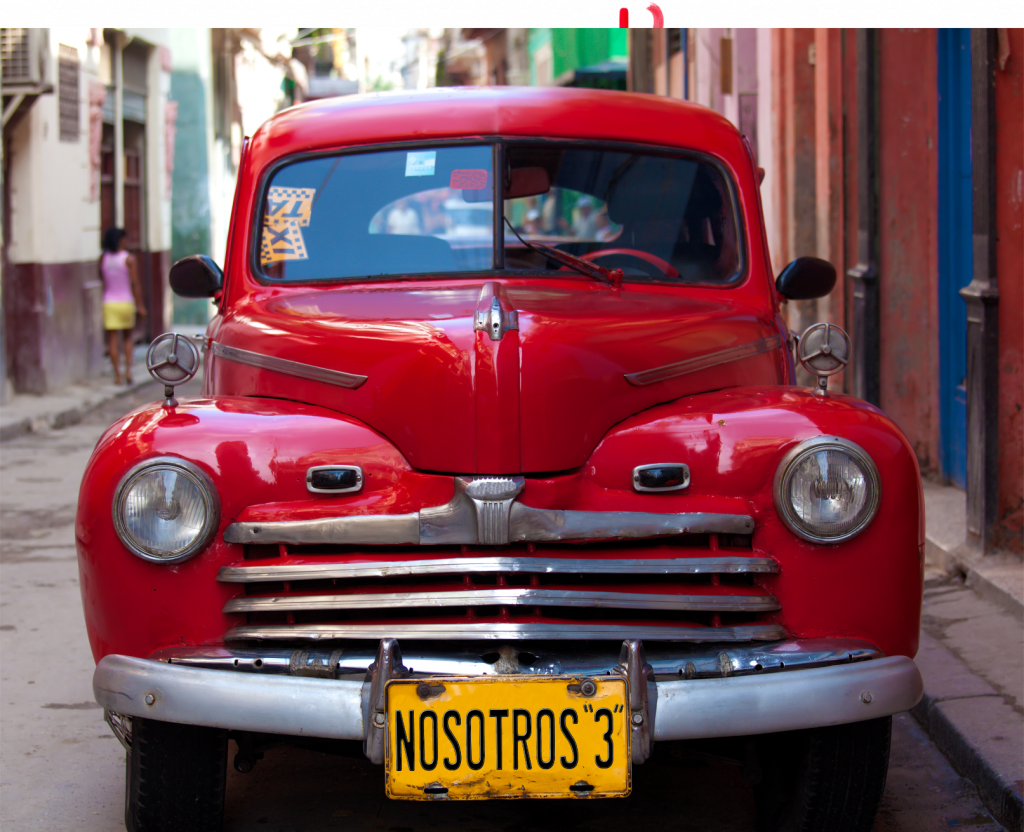
Timbales, congas, and bongos comprise the core of the quintessential Cuban percussion section. The iconic timbalero Tito Puente recorded the landmark album Puente in Percussion with congueros Mongo Santamaría and Carlos “Patato” Valdés, bongocero William “Bobo” Correa, and bassist Bobby Rodríguez. Only allowed to use the studio after midnight for the project, they created arrangements in studio based on various rhythms with the bass providing a foundation for the percussionists to play over producing tracks like “Four Beat Mambo,” the inspiration for this performance’s offering. It is a descarga, having the vibe of an improvisational jam. “Dále” can be understood as “Hit it!” or “Do it!”
Tim Zilar, can be found bongos in Spokane-based salsa band Son Dulce, and in high school bandrooms teaching drumline and percussion. He is also Instructor of Jazz Guitar at EWU, performing on that instrument in Spokane-based band Time Baby and pit orchestras.
Graduating senior Brayden Schultz musical diversity includes classical and jazz piano, drums, and a long-time affinity for and recent dedication to Latin percussion. On this one, I’m exercising the liberty of having the “three-o” refer to the percussion, but following Puente’s precedent in having a bass player join the party. Consider him the D’Artagnan to these “Three Musketeers.”
Acknowledgements and Thanks
God! I’m still trying to get it all done!
Valencia, my PR31 Woman!
Samuel and Daniel Singleton
Atiya Hodges and Jasmin Patterson, never forgotten and always close!
Keri McCarthy, WSU School of Music Director
Shaun Sorensen and his production crew
Ginger Sorenson, designer and seamstress extraordinaire!
The incredible faculty and staff of the WSU School of Music